Navigating Liquidation and the “Phoenixism” Trap
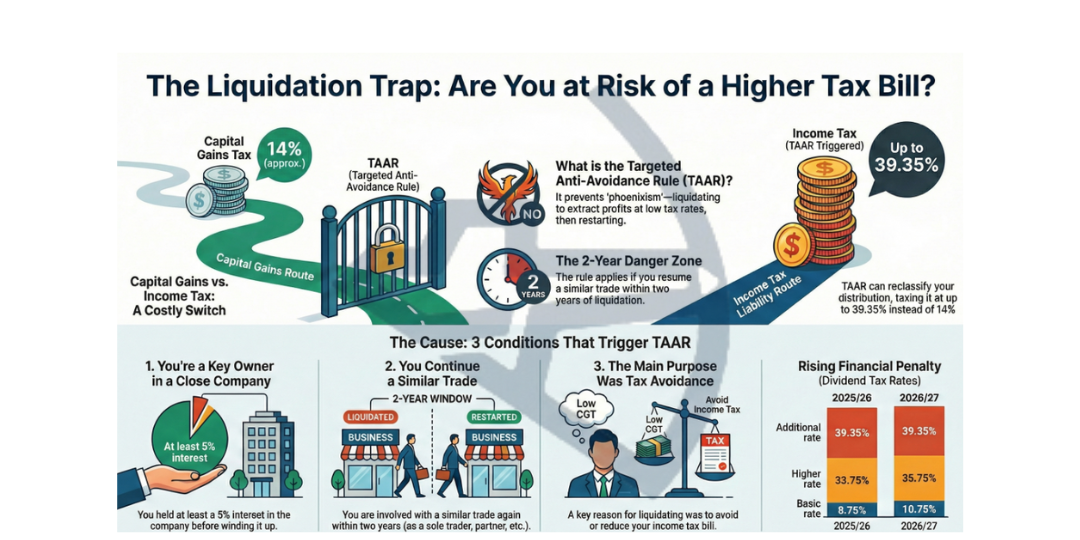
For many business owners, the end goal is to eventually liquidate (or sell) their company and receive the surplus funds as a capital distribution. Historically, this has been an effective way to access cash at lower Capital Gains Tax (CGT) rates, particularly through Business Asset Disposal Relief (BADR)
However, restarting a similar business too quickly can lead to a significant tax headache.
The Targeted Anti-Avoidance Rule (TAAR)
HMRC uses the TAAR to prevent “phoenixism”—the practice of winding up a company to extract profits as capital, only to start the same trade again shortly after. If the TAAR applies, your capital distributions could be re-taxed as income, with rates jumping from the lower CGT/BADR rates to as high as 39.35%.
When Does the TAAR Bite?
The rule generally applies if four specific conditions are met:
• Ownership: You held at least a 5% interest in the company before liquidation.
• Company Type: The company was a “close company” at or near the time of winding up.
• Timing: You start the same or a similar trade within two years of the final distribution. This includes operating as a sole trader, a partnership, or even as an employee for a connected person.
• Purpose: It is reasonable to assume the main purpose of the liquidation was to avoid or reduce income tax
Rising Rates and Growing Risks
The financial stakes are rising as BADR CGT rates increase from 10% in 2024/25 to 14% in 2025/26 and 18% in 2026/27. Furthermore, dividend tax rates for basic and higher-rate taxpayers are set to increase by 2% starting April 6, 2026. These changes make the potential “tax hit” from a TAAR investigation even more substantial.
The Importance of Commercial Justification
To avoid falling foul of these rules, there must be a commercial or exceptional reason for the liquidation
Speak to a Accountant at Archers Accountants to discuss your options