I’m not talking about IQ.
I’m talking about the ability to sit with one idea long enough to do something with it.
The ability to open a blank page and not reach for your phone within three minutes.
The ability to feel discomfort without immediately escaping it.
That is becoming the rarest skill alive.
And almost nobody talks about it this way.
Here’s What’s Actually Going On
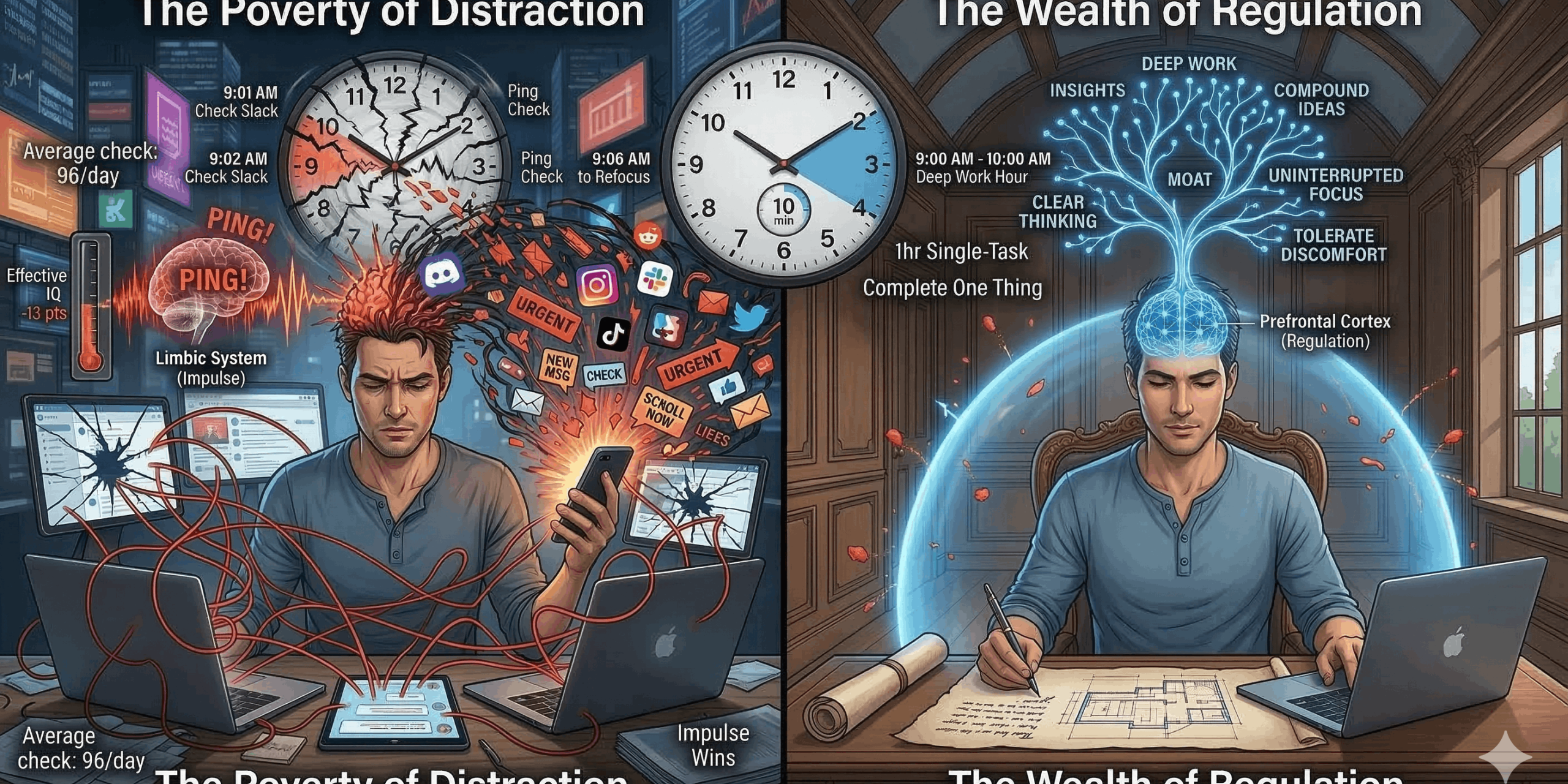
The average person checks their phone 96 times a day.
That’s once every 10 minutes.
Every check triggers a small dopamine release.
Your brain logs it: phone equals reward.
So it learns to crave the phone the moment boredom or discomfort shows up.
Not because you’re weak.
Because you were trained.
Every notification, every red dot, every scroll is the product of engineers at the most sophisticated companies in the world competing for one thing: your next 3 seconds of attention.
You’re not losing to laziness.
You’re losing to a system designed specifically to defeat you.
The Poverty Nobody Talks About
There’s a Harvard study I keep coming back to.
It found that our minds wander almost 47% of our waking hours.
Almost half your conscious life spent partially somewhere else.
Not present. Not creating. Not deciding.
Just… drifting.
Meanwhile, after a single distraction, it takes your brain 23 minutes to fully refocus.
23 minutes.
So you check Slack at 9 AM.
You don’t get back to full cognitive capacity until 9:23.
You respond to a text at 9:30.
You don’t get back until 9:53.
You never actually work.
You just move between interruptions while telling yourself you had a productive day.
40% of knowledge workers never get 30 uninterrupted minutes in a working day.
Let that land.
The kind of work that actually builds something — the deep, focused, uncomfortable kind — has become statistically rare.
Why This Is a Wealth Problem
The attention economy generated $700 billion in ad revenue last year.
Your distraction was the product.
Every minute you spent scrolling instead of building was monetized by someone else.
Researchers found that financial scarcity drops your effective IQ by 13 points — the equivalent of a sleepless night.
But here’s what I find more disturbing:
Chronic distraction creates the same cognitive impairment.
So it doesn’t matter how much money you have in your account.
If you can’t focus, you’re cognitively poor.
You’re trying to build something real with a mind that’s been systematically depleted.
What Mental Regulation Actually Is
Most people think self-discipline is about willpower.
White-knuckling through the urge to scroll.
Blocking apps and hoping it sticks.
That’s not regulation. That’s suppression.
And it always breaks eventually.
Mental regulation is different.
It’s the capacity of your prefrontal cortex — the part of your brain that handles planning, decision-making, and long-term thinking — to override the impulse-driven signals coming from your limbic system.
In plain language:
The part of you that wants to build something great vs. the part of you that just wants to feel okay right now.
Most people have the balance backwards.
Impulse wins 47% of the time.
The algorithm is built to make sure it does.
What The Regulated Person Can Do
I want to be specific here because I think this gets too philosophical too fast.
A mentally regulated person can:
Do hard things without external validation.
They write the article before it gets likes.
They build the product before people know it exists.
They work on the thing for months before it pays off.
Tolerate discomfort without escaping it.
Most creative work is uncomfortable.
The blank page is uncomfortable.
The idea that might not work is uncomfortable.
The regulated mind sits with that instead of opening Instagram to feel something easier.
Sustain attention long enough for ideas to compound.
One hour of uninterrupted thinking produces insights that no amount of fragmented browsing can match.
The best ideas don’t come from scrolling more.
They come from staying with one thought long enough to go deep.
Act without feeling ready.
The unregulated mind waits for certainty.
The regulated mind knows certainty is a myth and moves anyway.
This Is What I’ve Been Building Toward
Everything I write about in this publication — the nervous system, the second brain, cognitive performance, mental longevity, artificial intelligence — it all points here.
The future doesn’t belong to the most talented people.
It doesn’t belong to the most connected or the best-funded.
It belongs to the people who can still think clearly in an environment designed to prevent it.
The regulated mind is the new moat.
Not the app.
Not the team.
Not the funding round.
The brain that can sustain clarity under pressure for years.
What Actually To Do
I’m not going to give you a 30-step framework.
You’ve read those. They don’t stick.
Here are three things. Do them this week.
1. One hour of phone-free, single-task work every morning.
Not two hours. Not a whole morning.
One. Protect it like a meeting you can’t cancel.
Do the thing that matters most before you give your brain to anyone else.
2. Complete one thing before starting another.
Finish the email. Finish the paragraph. Finish the sketch.
Multitasking drops cognitive performance by 40%.
Stop half-doing everything and start fully doing one thing.
3. Let discomfort last 10 minutes before reacting.
Next time you want to check your phone — wait.
Set a timer. 10 minutes.
Most of the time, the discomfort passes.
And you realize you were never actually bored.
You were just trained to feel like you were.
The gap between the regulated and the distracted is going to widen fast.
It already is.
You’re reading this, which means some part of you already knows which side you want to be on.
That part is right.
By David Tost